The research.
Nobody’s Neighbours: Where Large Language Models Sit Among the World’s Values
Emre Yılmaz, independent researcher · October 2026
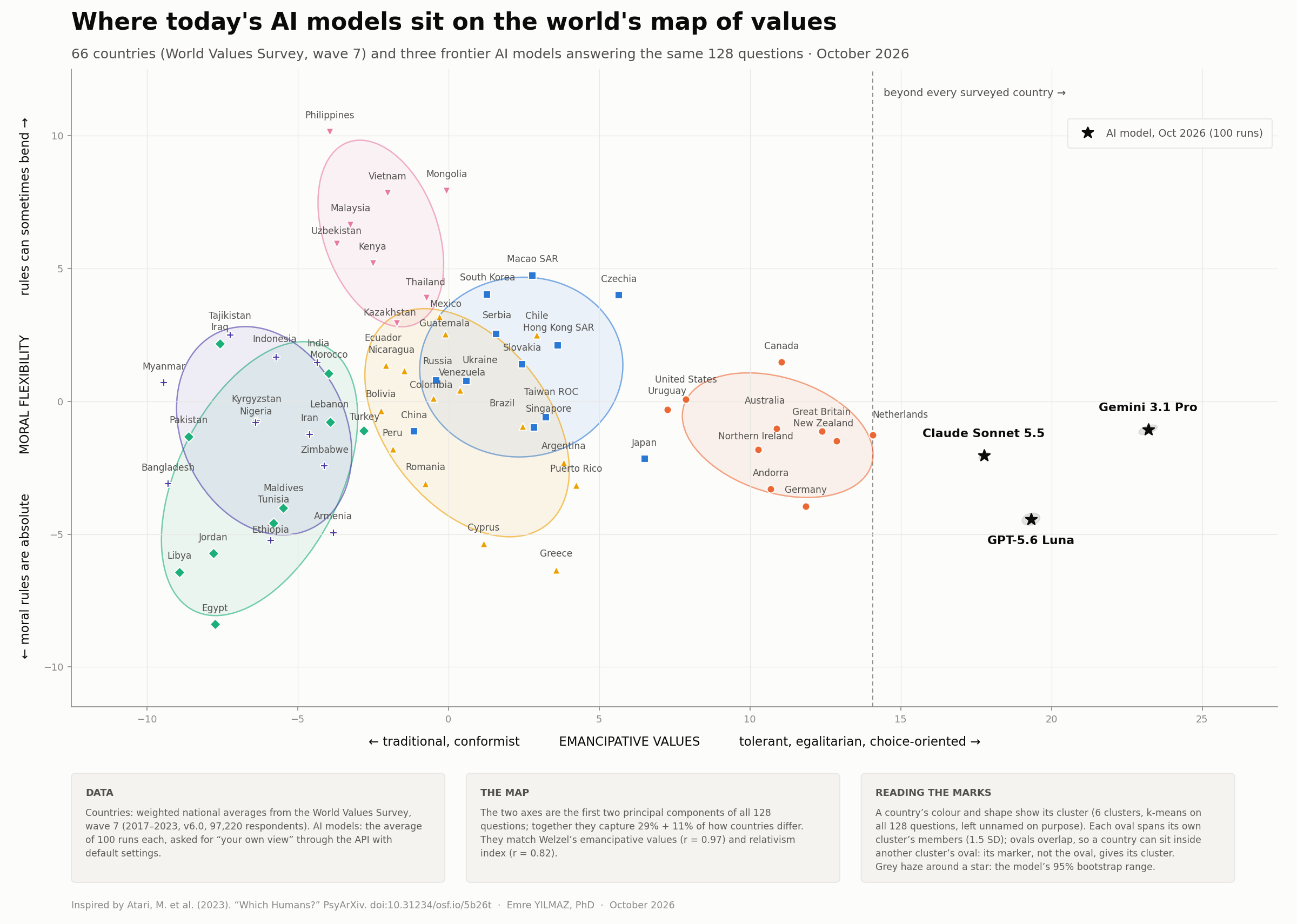
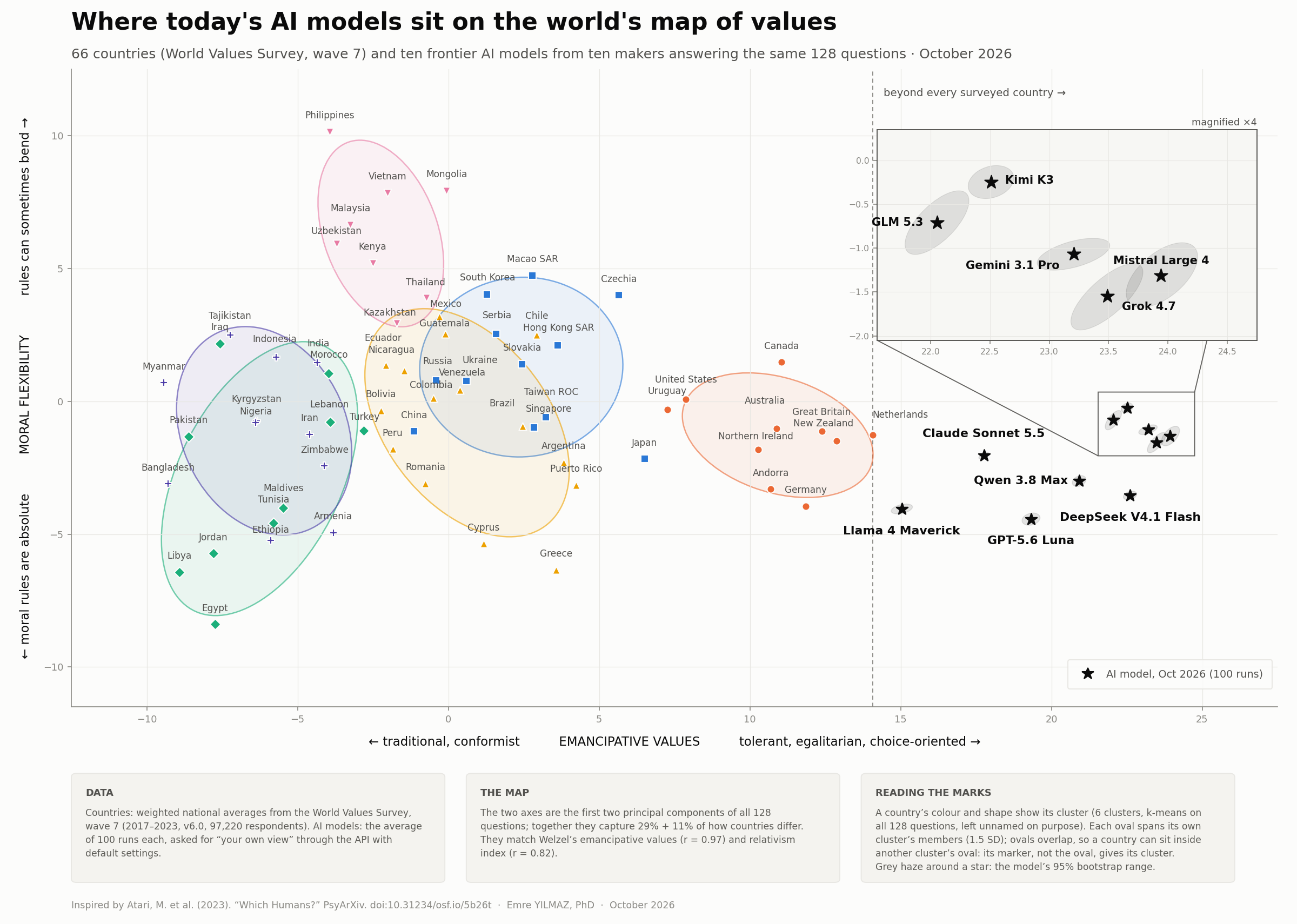
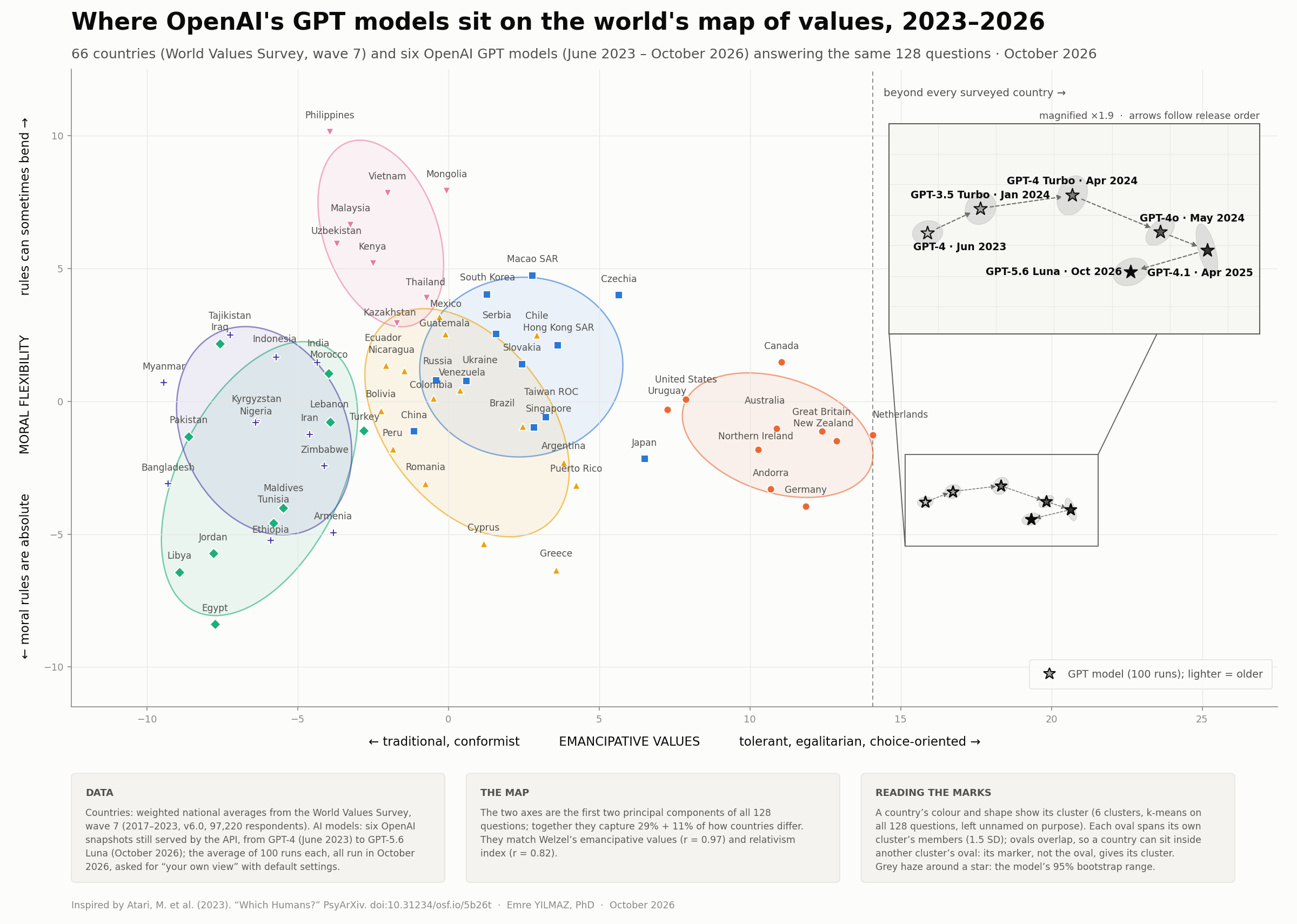
People in every part of the world now ask language models for advice on family, faith, work and politics, so the values these systems express are no longer an abstract concern. We put 128 questions from the seventh wave of the World Values Survey to seventeen large language models, a hundred times each, and placed their answers in a values space fitted on the national averages of 66 countries and territories (97,220 respondents). The models included three flagship assistants as of October 2026, one current model from each of ten developers in the United States, China and Europe, and six OpenAI models released between 2023 and 2026. Every model scored higher on emancipative values than any surveyed society, the most emancipative of which is the Netherlands. Across all 125 variables, each model’s nearest country was New Zealand, at a distance greater than that separating any country from its own nearest neighbour; in this sense the models are nobody’s neighbours. Models from different developers and countries of origin occupied the same small region, while successive OpenAI releases moved by as much as two typical countries differ, mostly along a dimension of trust in international institutions that the familiar two-axis map does not show. We discuss what it means for a widely used technology to sit outside the range of the societies it serves.
THE PEOPLE
The World Values Survey, wave 7 (2017–2023): 97,220 respondents in 66 countries and territories, as weighted national averages.
THE MACHINES
Seventeen models, asked 128 of the same questions in their own voice, a hundred times each, in October 2026, with each provider’s default settings.
THE MAP
A values space fitted on the 66 countries alone. Its first axis matches emancipative values (r = .975), its second moral flexibility (r = .815); a third carries institutional trust.
THE DISTANCES
Measured across all 125 variables at once. The most isolated country is 14.2 from its nearest neighbour; every one of the seventeen models is at least 18.3 from its nearest country.
THE ACADEMIC MAPS
DATA
The human baseline is the World Values Survey wave 7 country-pooled datafile, version 6.0 (Haerpfer et al., 2022), used under the survey’s own terms; respondent-level data are not redistributed. The aggregated results needed to follow the analysis are in the paper and its appendices; further aggregated data are available from the author on reasonable request.